Ground School is all about balance - the critical component of all movement. Balance
is the foundation upon which all other movement is built. Improving balance stabilizes
that foundation so that it can grow taller and taller. Imagine you are running on
a treadmill. With each step your foot must read the ground, balance, and take off
again. If balance is bad, it will take your foot longer to re-stabilize before the
next step, and these wasted milliseconds will start to add up. The better your balance,
the better your ground contact time (GCT). The better your GCT, the faster you will
move. If you can’t balance while standing still, you will be wasting precious energy
to maintain balance while you play. Balance has also been shown to be directly related
to brain health. The better your balance, the better your brain function (see more
on this in Cognitive School). Baseball is a game of moments, and those moments happen
fast. If we want our athletes to be as efficient as possible, they need to be functioning
optimally, and balance is the key.
Two Minute Club
The easiest way to start training balance is by standing on one leg. Stand on one
leg with eyes open and try to reach 60 seconds. If you stumble before 60, just record
the time, and repeat on the opposite side. With training we would like for all players
to reach 60 seconds for each side. Repeating this exercise daily is the best training
for this exercise.
Balance Protocol
Start by standing on left leg with right leg forward at 90 degrees. Try to hold
for 15 seconds. Repeat on opposite side. Once you can achieve 15 seconds on each
side, start performing the test with eyes closed. Once you reach 15 seconds eyes
closed on each side, repeat by standing on a foam cushion or pillow. It is important
not to raise the level until both sides can achieve 15 seconds. As you improve,
you can add levels of difficulty by employing more difficult surfaces, such as Bosu
ball, big round ball, tight rope, etc.
Walk the Line
This test can be done anywhere by putting down 15 feet of tape in a straight line
on the floor. The athlete is instructed to stand tall and go through the motion
of walking very slowly and exaggerated as if on a tight rope. As they bring their
knee up for each position, they hold for 3 seconds. The importance in this exercise
is to make sure the knee is brought up straight forward so that no angling of the
knee (valgus, or varus) is allowed. Performing the exercise on the line ensures
that both the foot on the ground and the foot being raised remain perfectly straight
as well. This will help to correct hip imbalances and strengthen any instabilities
in the athlete’s movement pattern.
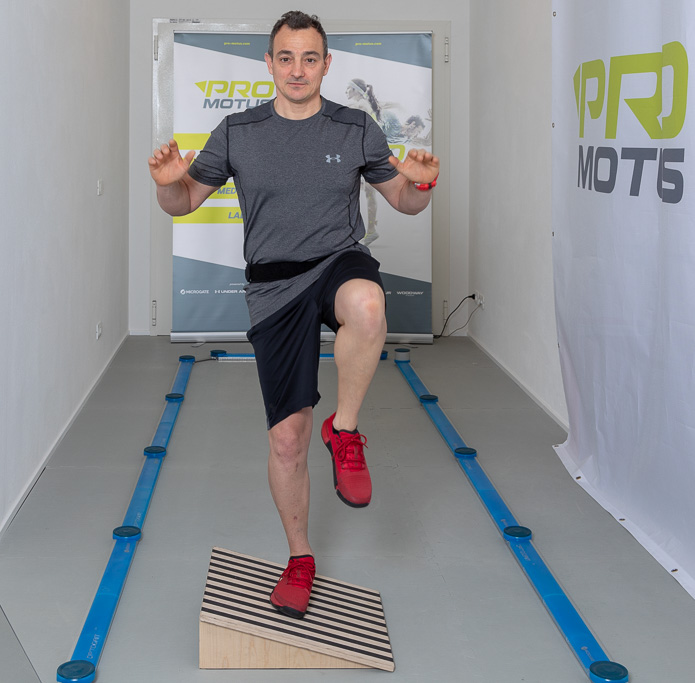
Slant Board Power-Ups
Your foot movement through its normal gait cycle (Dorsi-flexion, Supination, Pronation,
Plantar-flexion) can be mimicked by using a standard slant board. Each one of these
positions of the foot should be equally strong. To check this, have the athlete
place their foot on the slant board in the required position, and power-up bringing
the opposite leg to 90 degrees. Repeat for each foot in all 4 positions. The athlete
should be able to power up into a balanced position from all sides.